


Why GraphRAG Could Become the New Standard for AI Solutions | CSPC
— and Why We at CSPC Are Already Using It Today
The first generation of RAG systems marked an important step forward: documents are broken into smaller text segments, retrieved through semantic search, and then provided to a language model as context. For many straightforward use cases, this works well. But as soon as data becomes more complex, the limitations of traditional RAG approaches quickly become apparent. They can find relevant passages, but they often do not adequately understand the relationships between pieces of information. This is exactly where GraphRAG becomes interesting. Microsoft positions GraphRAG as an approach that combines knowledge extraction, graph structures, and LLM-based summarization to make complex datasets far more usable.
The Real Difference: Data Is Structured on a New Level
The biggest advantage of GraphRAG is not just that it can generate better answers. Its real value begins much earlier — in the way knowledge itself is prepared.
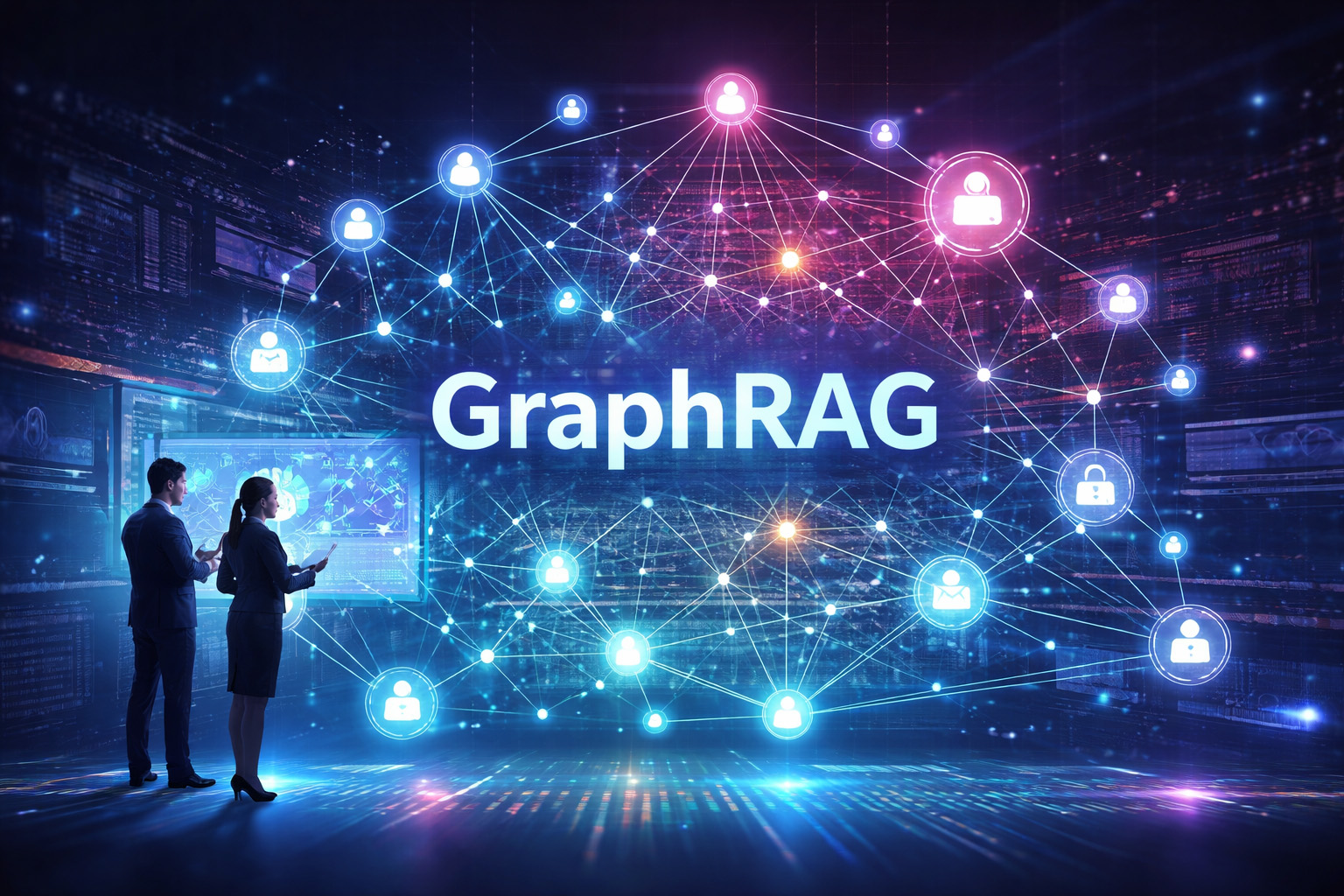
Traditional RAG fundamentally works with fragments of text. GraphRAG, by contrast, elevates information to a new level: unstructured content is transformed into entities, relationships, clusters, and thematic connections. Instead of simply retrieving similar passages, it creates a structured knowledge space. Microsoft describes this as one of GraphRAG’s key strengths, especially for complex data exploration and for questions that go beyond isolated text snippets.
Put simply: traditional RAG helps you find information. GraphRAG helps you understand it.
Why This Matters So Much for Businesses
Business knowledge is rarely stored neatly in a single source. It is spread across documentation, tickets, emails, reports, CRM entries, support cases, and project data. All of this information is interconnected — yet traditional retrieval approaches often treat it as isolated pieces of text.
That is why GraphRAG is fundamentally superior in many scenarios: it allows these relationships to be modeled explicitly. Products are connected to customers, customers to requests, requests to issues, issues to root causes, root causes to processes, and processes to responsibilities. In practice, these connections are what make the difference between a superficial AI response and one that is genuinely useful. Microsoft also highlights that GraphRAG shows particular strength when dealing with complex questions across private and narrative datasets.
Why We at CSPC Take This So Seriously
For us, GraphRAG is not an abstract concept for the future. It is a very concrete step in the evolution of modern software solutions.
CSPC (CS & Partner Consulting Ltd.) supports companies in Germany, Austria, and Switzerland with consulting and nearshoring services, while providing access to highly qualified IT professionals from Mauritius. On our website, CSPC highlights its focus on software development, ICT environments, and practical solutions for clients across the DACH region.
It is precisely in this context that the growing importance of GraphRAG becomes clear. Today, customers are not simply looking for any AI solution. They expect systems that can structure, connect, and operationalize complex information more reliably.
That is why we are already using this technology in new versions of our solutions for customers. For us, GraphRAG is the logical next step because it allows us not only to search data, but to structure it on a higher semantic level. This leads to applications that understand relationships more effectively, deliver more precise answers, and unlock significantly greater business value from existing data sources.
CSPC: Swiss Quality Standards, Modern AI Development from Mauritius
CSPC positions itself as a nearshoring partner with Swiss roots and a development base in Mauritius. The company emphasizes its combination of Swiss quality standards, efficient collaboration, and modern software engineering.
The strategic importance of AI and AI-driven software development at CSPC is also visible beyond the website itself. In a recent LinkedIn post, CSPC described its exchange with the Swiss Ambassador to Mauritius about the future of AI-driven software development and the presentation of its “Software with AI-Driven Value” offering. The company highlighted key values such as quality, reliability, data protection, and a strong focus on security.
This fits perfectly with the GraphRAG approach. In professional client projects, it is not enough for a system to seem impressive. It must be understandable, dependable, and capable of being integrated cleanly into real-world data environments. That is exactly why structured knowledge preparation is so critical.
Why GraphRAG Could Become the Standard
GraphRAG has the potential to become the new standard because it directly addresses one of the core weaknesses of today’s GenAI systems: many solutions are strong in language processing, but still not strong enough in knowledge structuring.
The future will very likely belong to systems that combine both:
linguistic intelligence and structural understanding.
GraphRAG offers a powerful model for exactly that. It transforms scattered and unstructured data into more than just a searchable surface — it creates a usable knowledge foundation. This allows companies not only to find information faster, but also to identify patterns, understand dependencies, and make better-informed decisions.
Conclusion
GraphRAG could become the new standard because it takes data to a new level. Instead of treating knowledge as nothing more than blocks of text, it makes relationships, themes, and context systematically visible.
And that is exactly why we at CSPC are already using this technology in new customer solutions: because we are convinced that modern AI should not merely retrieve content, but structure knowledge more intelligently.
For us, GraphRAG is therefore not just a technical trend. It is a real quality upgrade for the next generation of data-driven applications.